

Shoppers comparing muscle stimulator systems often want to know how a single targeted device differs from a full kit built for an entire training session. APE BORN Fitness sells several product lines that fit under this umbrella, from single-area stimulators to a full-coverage suit. This breakdown looks at coverage, device count, and session scope across the range, and it points out where the various muscle stimulator systems actually diverge from one another.
Understanding NMES Technology in APE BORN Stimulators
Most of the APE BORN Fitness lineup runs on Neuro-Muscular Electrical Stimulation, commonly shortened to NMES. The technology sends impulses through gel pads to mimic the contractions that happen during active training. The brand describes its NextGen Ultra Muscle Stimulator as delivering over 600 deep muscle contractions in a single session, with sessions typically running around 20 minutes. That contraction count and session length form a baseline that other systems in the catalog can be measured against.
NextGen Ultra Single-Area Stimulators: Abs, Arms, Glutes, Thighs and Calves
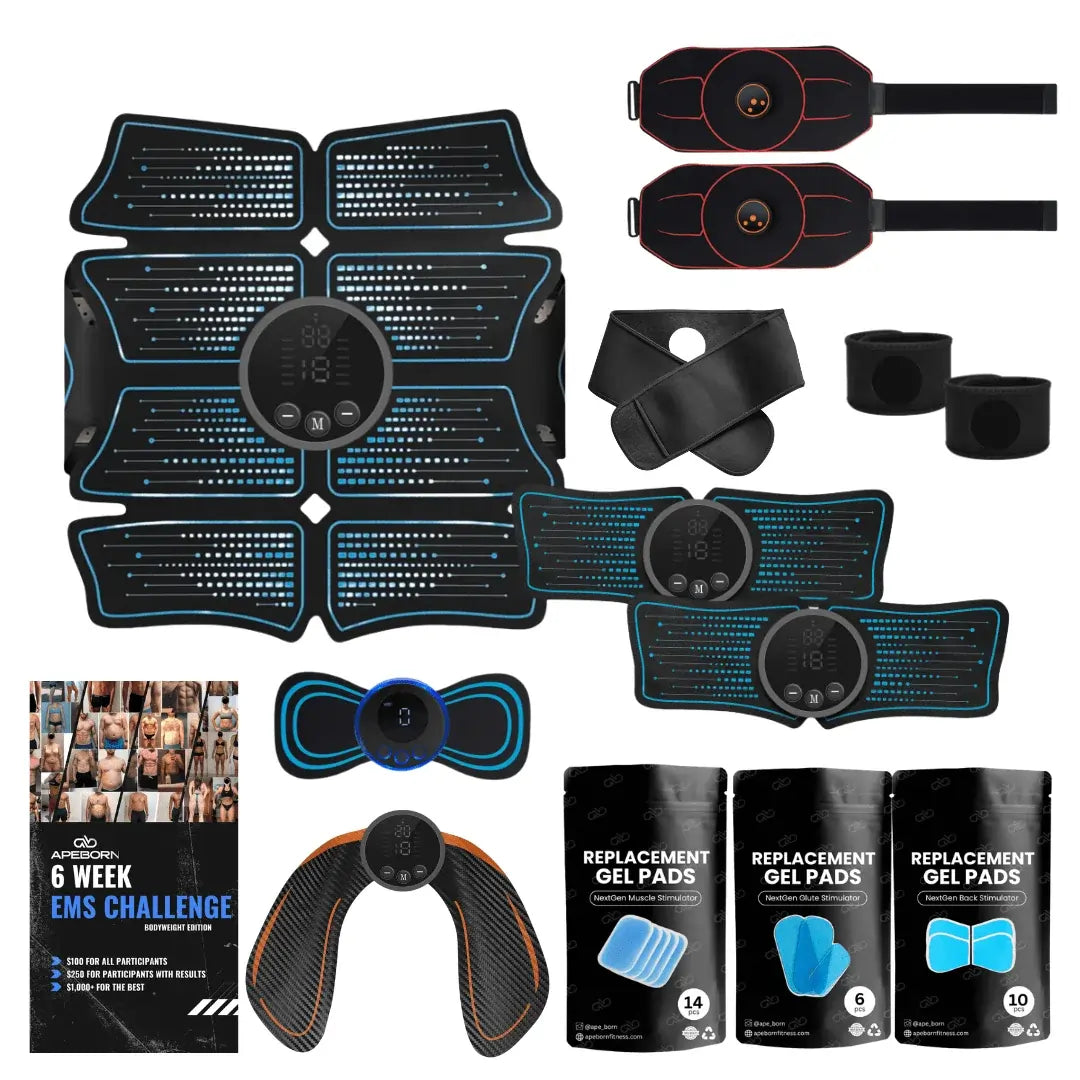

The single-area devices are built around one specific muscle group rather than a combined routine, which keeps each device suited to a narrow target zone instead of a full-body session. The NextGen Ultra Muscle Stimulator targets the abs and arms, while the NextGen Ultra Glute Stimulator focuses on glute activation for lower body training. The NextGen Ultra Thigh Stimulator and the NextGen Ultra Calf Stimulator are each sold separately as standalone pieces, so a person focused on one lower-body area does not need the rest of the catalog to use either one.
Because each device is dedicated to a single muscle group, the training scope of any one stimulator stays narrow by design. Anyone wanting broader coverage across more than one area at a time would look toward the combination kits instead.
NextGen Ultra Multi-Device Kits: Combining Targeted Stimulators
APE BORN Fitness also bundles its targeted stimulators into combination kits for people who want more than one muscle group covered without buying each piece separately. The NextGen Ultra Thigh & Calf Stimulators kit pairs the thigh and calf devices into one four-device bundle, and the brand describes the pairing as delivering the equivalent of 60 minutes of squats and calf raises from a 20-minute session, framing it as a lower-body-specific alternative to buying the thigh or calf stimulator on its own. The pairing effectively doubles the areas addressed in one sitting compared to a single device.
This combination option sits between the narrow single-area stimulators and the full-coverage kit discussed next. It gives a path for someone who wants two connected muscle groups activated together, specifically the lower body, without stepping up to abs, arms, thighs, and calves in one session. For that broader scope, APE BORN Fitness offers a dedicated full-body kit.
NextGen Full Body EMS Suit: The Premium Full-Coverage Option

At the top of the range sits the NextGen Full Body EMS Suit, a wearable system described by the brand as using SmartWave Electrical Muscle Stimulation to activate every major muscle group simultaneously. Unlike the single-area devices or the four-device kit, the suit is worn as one piece rather than assembled from separate stimulator units. The brand describes it as replacing a full workout session in one wearable format, aimed at covering the whole body rather than isolated regions.
This suit represents a different category of muscle stimulator systems compared to the strap-based devices. Where the targeted stimulators and kits rely on separate pads placed on specific areas, the suit is framed as a single garment covering the major muscle groups together. That distinction matters for anyone deciding between assembling several targeted pieces or choosing one full-coverage garment.
Hands-Free Muscle Activation Across All APE BORN Tiers
A feature that carries across the single stimulators, the combination kits, and the full-body kit is hands-free operation. APE BORN Fitness describes its Ultra stimulator sessions as 100% hands-free, with devices described as rechargeable and reusable without gel pad replacements. This hands-free quality applies whether the device is targeting one muscle group or several at once, so the operating experience stays consistent across the catalog even as coverage changes.
The brand also notes its NextGen Ultra Muscle Stimulator carries FDA clearance, and cites a figure of 94% of people seeing visible toning within 60 days, a claim tied to its clinically proven NMES technology. These figures describe the single Ultra stimulator specifically, and they help frame what the broader line of muscle stimulator systems is built around, which is consistent, repeatable sessions rather than one-off use.
Choosing Between APE BORN Stimulator Systems
Deciding among the options comes down to how many muscle groups need coverage in a single session and how much equipment feels practical to manage. A single targeted stimulator suits a narrow focus, a multi-device kit extends that to a paired region such as the lower body, and the full kit or suit extends coverage further still. The points below outline how these parts of the catalog separate from one another.
- Single-area stimulators such as the glute, thigh, or calf devices cover one muscle group per session.
- The NextGen Ultra Thigh & Calf Stimulators kit combines two lower-body devices for a paired 20-minute session.
- The NextGen Ultra Full Body Stimulator Kit brings four devices together to address abs, arms, thighs, and calves in one session.
- The NextGen Full Body EMS Suit is worn as a single garment rather than assembled from multiple separate units.
- Session duration stays close to 20 minutes across the single stimulators and the combination kits alike.
Each of these options scales device count and activation scope differently, while keeping a similar session length. That makes the decision less about technology and more about how many areas a session needs to reach.
Closing Thought
Across the range, the real distinction among these muscle stimulator systems is coverage rather than complexity.